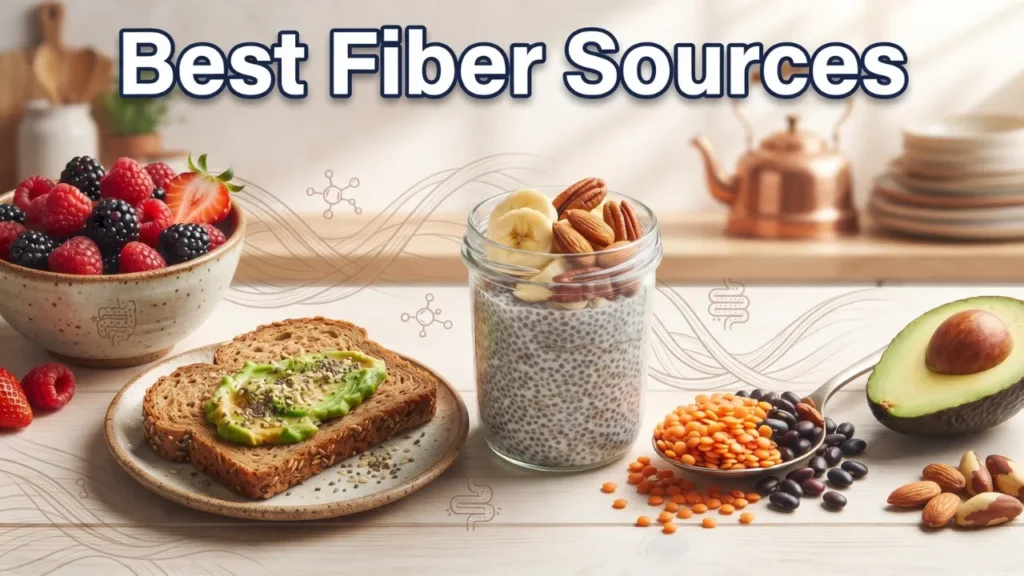
Fiber is the one dietary component that most people know they should be eating more of and consistently do not. The best fiber sources are not complicated health foods or expensive supplements; they are everyday whole foods that are available in any grocery store and that do more for your hunger management, gut health, blood sugar, and long-term weight loss than almost any other single dietary change you can make. Getting fiber right changes how full you feel, how stable your energy is, and how well your body functions every single day.
This guide covers fifteen specific fiber source categories with clear, practical information about which foods provide the most, how they work in the body, and how to incorporate them consistently into everyday eating without overhauling your entire diet.
What Dietary Fiber Actually Is
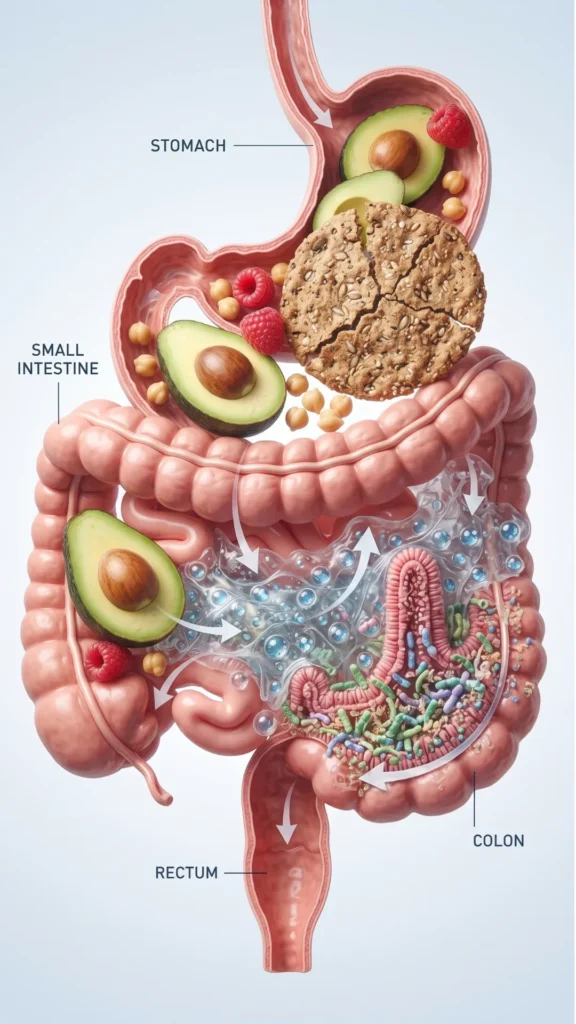
Dietary fiber is the indigestible portion of plant foods, the structural components of cell walls and plant tissues that pass through the small intestine without being broken down into nutrients and absorbed. Unlike carbohydrates, protein, and fat, fiber does not provide calories in the traditional sense; it moves through the digestive system largely intact, doing its most important work in the large intestine.
This indigestibility is what makes fiber so valuable. In the stomach and small intestine, fiber adds physical bulk and slows the movement of food, producing physical fullness and stabilizing the rate of nutrient absorption. In the large intestine, fiber becomes food for the beneficial bacteria of the gut microbiome, which ferment it into short-chain fatty acids that signal fullness to the brain, reduce inflammation, support immune function, and contribute to metabolic health.
Fiber comes in two main forms, soluble and insoluble, which work through different mechanisms and are found in different food sources. Most whole plant foods contain both types in varying proportions, which is one reason eating a variety of fiber-rich whole foods produces better health outcomes than focusing on a single source.
How Much Fiber You Need Every Day
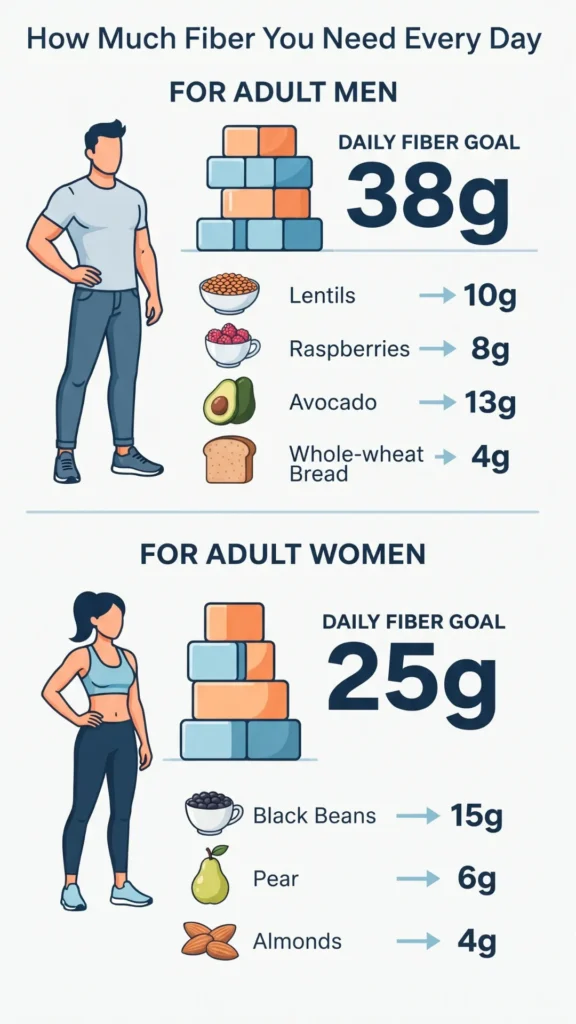
General guidelines recommend 25 grams of dietary fiber per day for women and 38 grams per day for men. These figures represent the intake associated with meaningful reductions in cardiovascular disease risk, improved blood sugar management, healthy gut function, and sustainable weight management.
The average adult eating a typical Western diet consumes approximately 10 to 15 grams of fiber per day, significantly below even the minimum recommendation. This gap is one of the most consistent nutritional shortfalls in modern diets. It is directly linked to elevated rates of digestive disorders, blood sugar instability, excess appetite, and poor gut microbiome diversity.
Increasing fiber intake should be done gradually, adding 3 to 5 grams per week rather than jumping from 12 to 38 grams in a single day. Rapid fiber increases cause bloating, cramping, and digestive discomfort for most people as the gut microbiome adjusts to the increased substrate. Adequate Water intake is also essential when increasing fiber; fiber absorbs Water in the digestive tract, and insufficient hydration alongside high fiber intake produces constipation rather than the smooth digestive function that is the goal.
You might like this: https://volueat.com/wp-admin/post.php?post=1360&action=edit
Beans and Legumes: The Most Fiber-Dense Foods Available
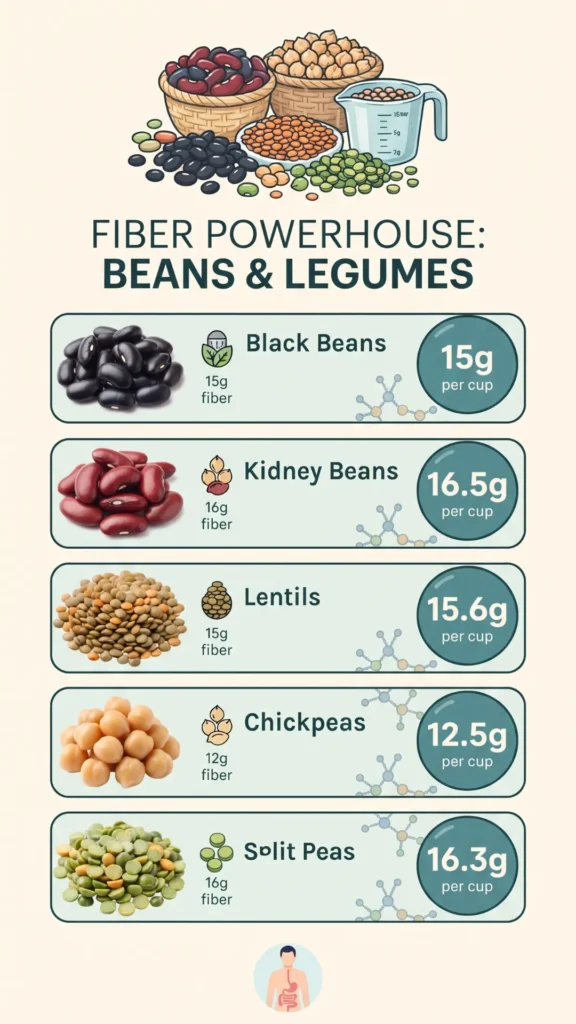
Beans and legumes are the single best fiber sources available in any common grocery store, providing exceptional fiber per serving alongside significant protein, making them uniquely powerful for both digestive health and appetite management.
Black beans provide approximately 8.7 grams of fiber per 100 grams cooked, one of the highest fiber densities of any commonly eaten food. Kidney beans provide 7.4 grams per 100 grams cooked. Cannellini beans provide 6.3 grams. Navy beans, also known as haricot beans, provide approximately 10.5 grams per 100 grams cooked, the highest of any common bean variety.
Canned beans require no preparation beyond draining and rinsing; they are immediately ready to add to salads, soups, stews, and bowls. Dried beans cooked from scratch provide identical nutritional value at a fraction of the cost. A pot of beans cooked on Sunday provides multiple high-fiber meal additions across the week with minimal daily effort.
The combination of fiber and protein in beans produces a satiety effect that neither provides alone. A half-cup serving of black beans provides approximately 7.5 grams of fiber and 7.5 grams of protein, a combination that stabilizes blood sugar, feeds gut bacteria, and keeps hunger suppressed for a considerably longer period than a carbohydrate or protein source of equivalent calorie count without the other macronutrient present.
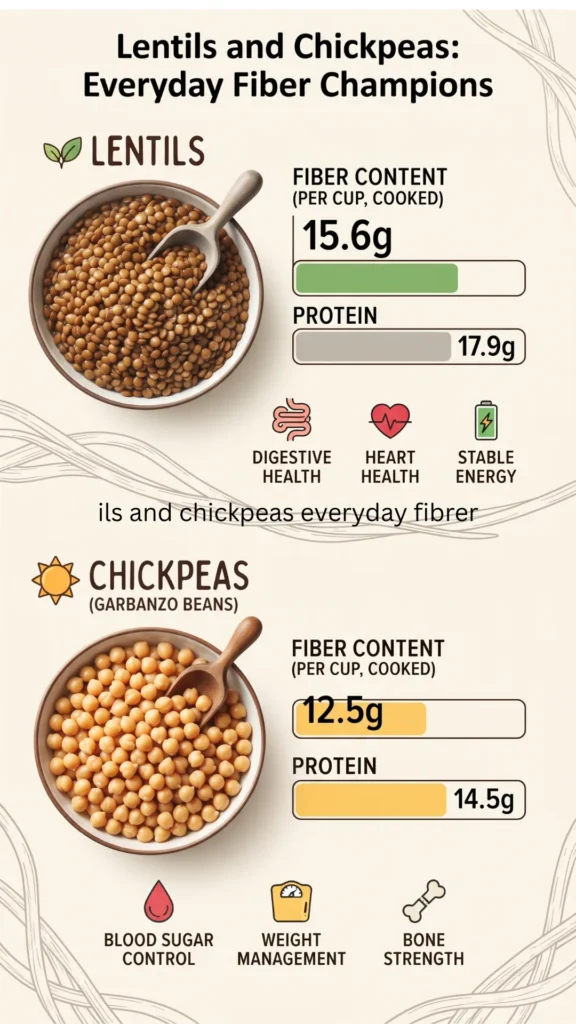
Lentils and Chickpeas: Everyday Fiber Champions
Lentils are the most practical everyday legume for fiber intake; they cook in 20 minutes from dried without soaking, cost a fraction of most other protein sources, and provide approximately 8 grams of fiber per 100 grams cooked alongside 9 grams of protein.
Red lentils break down and become creamy during cooking, producing naturally thick soups and dal sauces that are among the most filling, low-calorie meals available. Green and black lentils hold their shape better and work well in salads, grain bowls, and cold dishes where texture matters. A large pot of red lentil soup made on Sunday provides five to six individual servings of one of the most fiber-rich, protein-rich, and genuinely satisfying meals available for its calorie investment.
Chickpeas provide approximately 7 grams of fiber per 100 grams cooked alongside 9 grams of protein at 164 calories, a very favorable combination for any meal that needs to be both filling and nutritionally complete. Roasted chickpees, two tablespoons, provide approximately 2 grams of fiber for 60 calories, making it one of the best fiber-rich dip and snack components available.
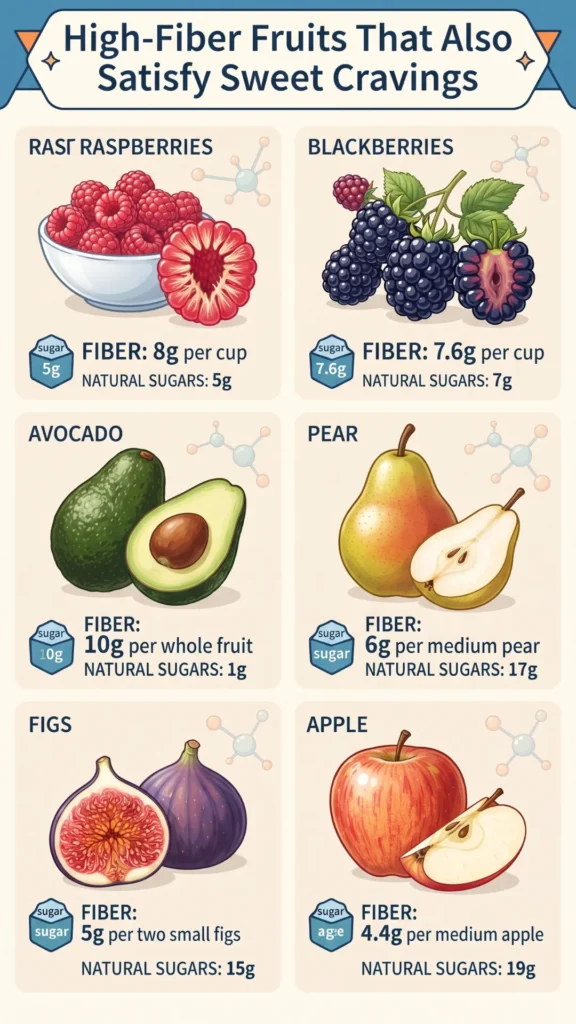
High-Fiber Fruits That Also Satisfy Sweet Cravings
Fruits provide fiber alongside natural sweetness, Water content, vitamins, and antioxidants, making them one of the most enjoyable routes to increased daily fiber intake. The fiber in a whole fruit also significantly moderates the glycemic impact of the natural sugars, which is why eating a whole apple produces a very different blood sugar response from drinking a glass of apple juice.
Pears are among the highest-fiber fruits available, with approximately 3.1 grams of fiber per 100 grams, with most of it concentrated in the skin. Eating pears unpeeled provides significantly more fiber than peeled pears. A medium pear provides approximately 5.5 grams of fiber for around 100 calories. Apples provide approximately 2.4 grams of fiber per 100 grams, again concentrated in the skin, making eating apples whole and unpeeled the more nutritious choice.
Guava is one of the highest-fiber fruits available at approximately 5.4 grams per 100 grams, outstanding for a fruit, at just 68 calories. Pomegranate seeds provide approximately 4 grams of fiber per 100 grams. Kiwi provides approximately 3 grams of fiber per 100 grams alongside exceptional vitamin C content. Avocado is technically a fruit and provides approximately 6.7 grams of fiber per 100 grams, the highest of any common fruit. alongside healthy fats that contribute to satiety.
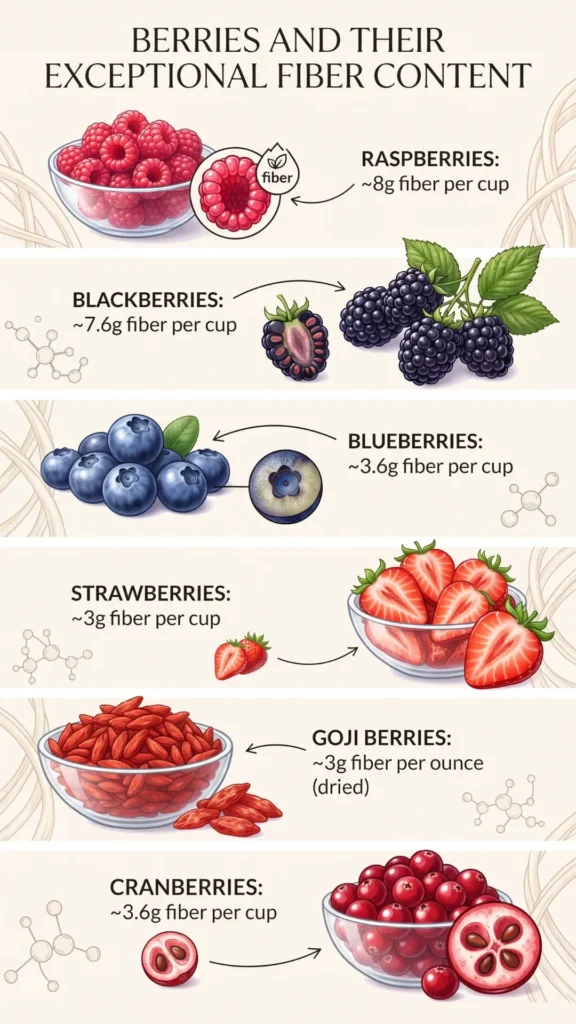
Berries and Their Exceptional Fiber Content
Berries deserve their own section because they consistently rank among the best fiber sources of any fruit category while also providing the highest antioxidant content, lowest glycemic impact, and most natural sweetness per calorie of any fruit group.
Raspberries are the standout. At 6.5 grams of fiber per 100 grams and just 52 calories, they provide the best fiber-to-calorie ratio of any common fruit by a significant margin, more fiber than a slice of whole grain bread for fewer calories and in a far more enjoyable form. A generous 150-gram bowl of raspberries provides nearly 10 grams of fiber for under 80 calories, an exceptional fiber contribution for a snack.
Blackberries follow closely at approximately 5.3 grams of fiber per 100 grams and 43 calories. Strawberries, at 2 grams of fiber per 100 grams and 32 calories, are slightly lower in fiber density but compensate with very high Water content and extremely low calorie density that makes them ideal for volume-eating applications.
Frozen berries are nutritionally equivalent to fresh and significantly cheaper; a large bag of frozen mixed berries provides weeks of high-fiber breakfast and snack additions at a fraction of the cost of fresh equivalents. Allowing frozen berries to defrost overnight in the fridge or briefly at room temperature before use produces exactly the same nutritional benefit as fresh.
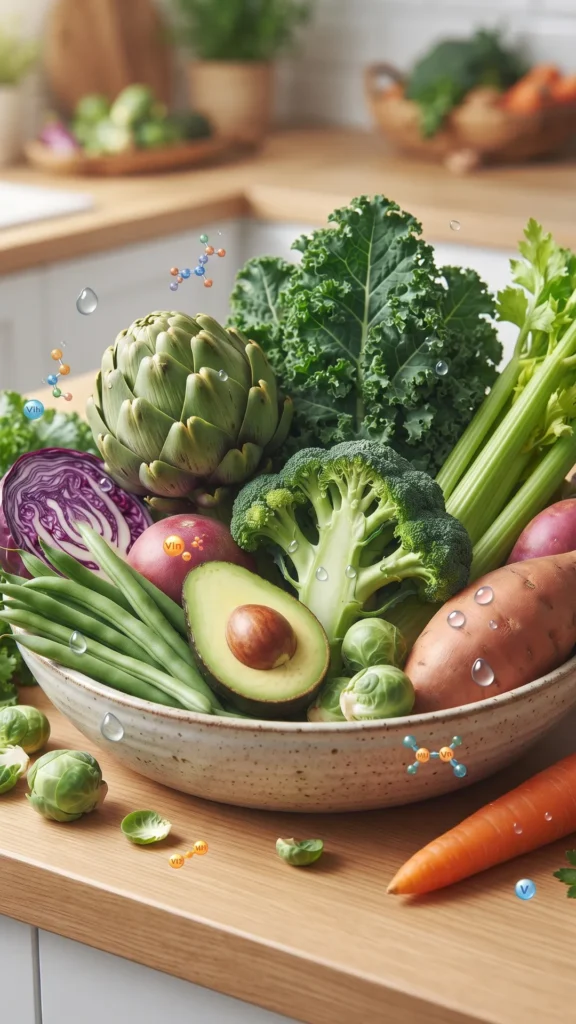
High-Fiber Vegetables That Add Volume and Nutrients
Vegetables provide fiber alongside Water content, vitamins, minerals, and antioxidants at the lowest calorie density of any food category, making them the most efficient fiber source available per calorie consumed.
Artichokes are the fiber champions of the vegetable world. A medium artichoke provides approximately 7 grams of fiber for approximately 60 calories, an extraordinary fiber-to-calorie ratio that makes them the most fiber-dense vegetable available by a significant margin. They require more preparation than most vegetables but reward the effort with exceptional nutritional return.
Brussels sprouts provide approximately 3.8 grams of fiber per 100 grams at just 43 calories. Broccoli provides 2.6 grams per 100 grams at 34 calories. Peas provide approximately 5.1 grams per 100 grams, higher than most people expect from what is often thought of as a simple vegetable, at 81 calories. Sweet potato provides approximately 3 grams of fiber per 100 grams at 86 calories, making it a more filling carbohydrate base for meals than white potato or white rice.
Carrots, parsnips, turnips, and beetroot all provide 2 to 4 grams of fiber per 100 grams alongside meaningful micronutrient content. These root vegetables work in roasted vegetable trays, soups, stews, and raw snacking applications, providing consistent fiber contributions across different cooking contexts.
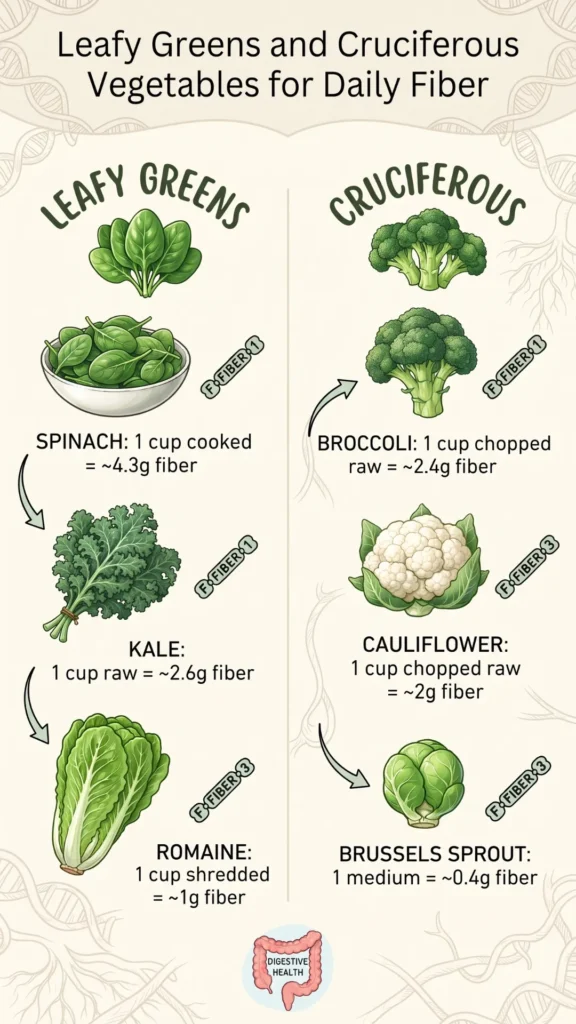
Leafy Greens and Cruciferous Vegetables for Daily Fiber
Leafy greens and cruciferous vegetables are the most commonly underestimated fiber sources because their fiber content is overshadowed by their other nutritional headlines, vitamins, antioxidants, and phytonutrients. In practice, eaten in the large quantities that volume eating encourages, they provide meaningful daily fiber contributions.
Kale provides approximately 2 grams of fiber per 100 grams at just 35 calories. Eaten in the generous 200-gram servings typical of volume-eating salads, kale contributes 4 grams of fiber per serving for 70 calories, a meaningful fiber contribution from a single meal component. Spinach provides approximately 2.2 grams of fiber per 100 grams at 23 calories; again, in large quantities, it becomes a consistent daily fiber contributor.
Cauliflower at 2 grams of fiber per 100 grams and cabbage at 2.5 grams per 100 grams are both commonly eaten in large volumes in volume-eating meals, particularly cauliflower rice as a base ingredient, providing fiber contributions that accumulate significantly across multiple daily servings.
Whole Grains That Are Richest in Fiber
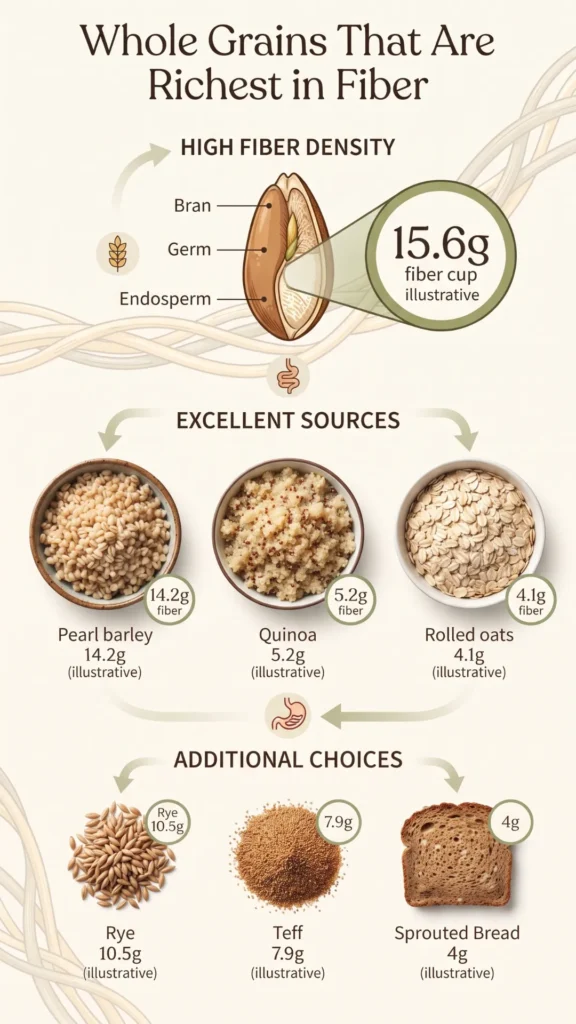
Whole grains provide fiber in a familiar, practical form that fits into existing meal structures without requiring significant dietary behavior change. The key distinction is between refined grains, white flour, white rice, and regular pasta, which have had their fiber-containing outer layers removed, and whole grains, which retain the bran and germ alongside the endosperm.
Oats are the most important breakfast grain for fiber. A 50-gram dry serving provides approximately 5 grams of fiber, primarily as beta-glucan soluble fiber that forms a gel in the digestive tract and produces exceptionally strong and long-lasting satiety. Research on oat beta-glucan consistently shows it produces better post-meal fullness than any other common breakfast grain at equivalent calorie counts.
Barley provides even more beta-glucan per serving than oats, approximately 3.8 grams of fiber per 100 grams cooked, with particularly high soluble fiber content. Used in soups and stews, barley expands significantly during cooking, providing physical volume alongside its fiber contribution. Quinoa provides approximately 2.8 grams of fiber per 100 grams cooked alongside its complete protein profile, making it one of the most nutritionally complete grain options. Brown rice provides 1.8 grams of fiber per 100 grams cooked, which is modest individually but consistent across multiple daily servings.
Nuts and Seeds as Concentrated Fiber Sources
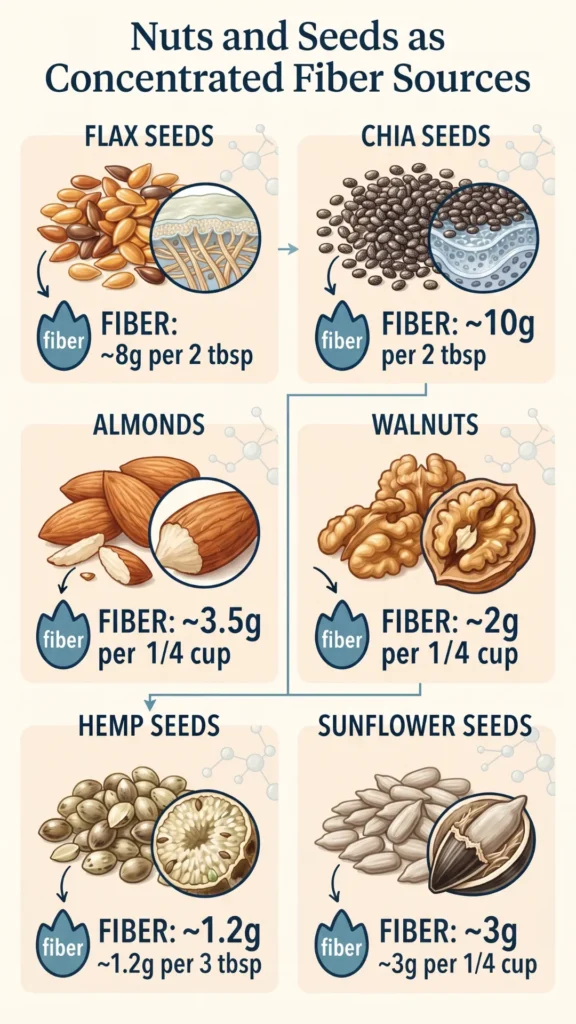
Nuts and seeds provide fiber in a concentrated form; small quantities contribute meaningfully to daily totals because their fiber density per gram is high relative to most other foods. Their calorie density means they are best used as measured additions to meals rather than free-eating snacks.
Chia seeds are the outstanding fiber source in this category. At approximately 34 grams of fiber per 100 grams, the highest fiber density of any commonly available food, two tablespoons of chia seeds provide nearly 10 grams of fiber for approximately 140 calories. Their ability to absorb liquid and expand to many times their dry volume makes them uniquely useful for creating high-fiber puddings and increasing the physical volume of liquid-based meals and snacks.
Ground flaxseed at approximately 27 grams of fiber per 100 grams provides 2 grams of fiber per tablespoon for 37 calories, an almost invisible fiber addition to oats, yogurt, and smoothies. Almonds provide approximately 3.5 grams of fiber per 30-gram serving, which is meaningful when consumed regularly. Pumpkin seeds provide approximately 1.7 grams of fiber per tablespoon. Sunflower seeds and walnuts provide comparable fiber contributions alongside their healthy fat content.
High-Fiber Breakfast Foods That Start the Day Well
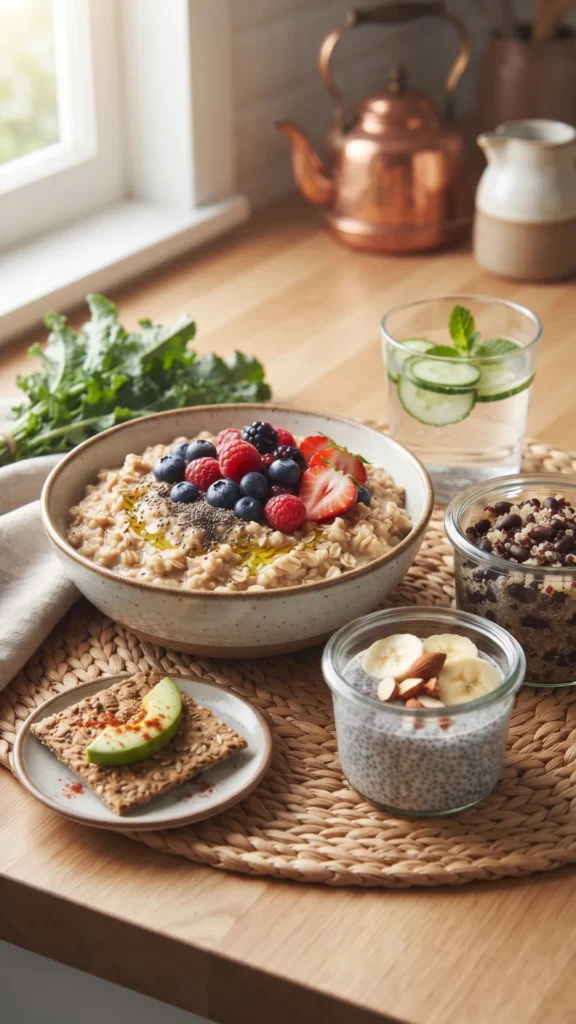
Breakfast is the meal that most determines daily fiber intake trajectory, and a fiber-rich breakfast that stabilizes blood sugar from the morning produces better hunger management and better food choices across the entire day than a low-fiber breakfast that produces a blood sugar spike and subsequent crash before 10 am.
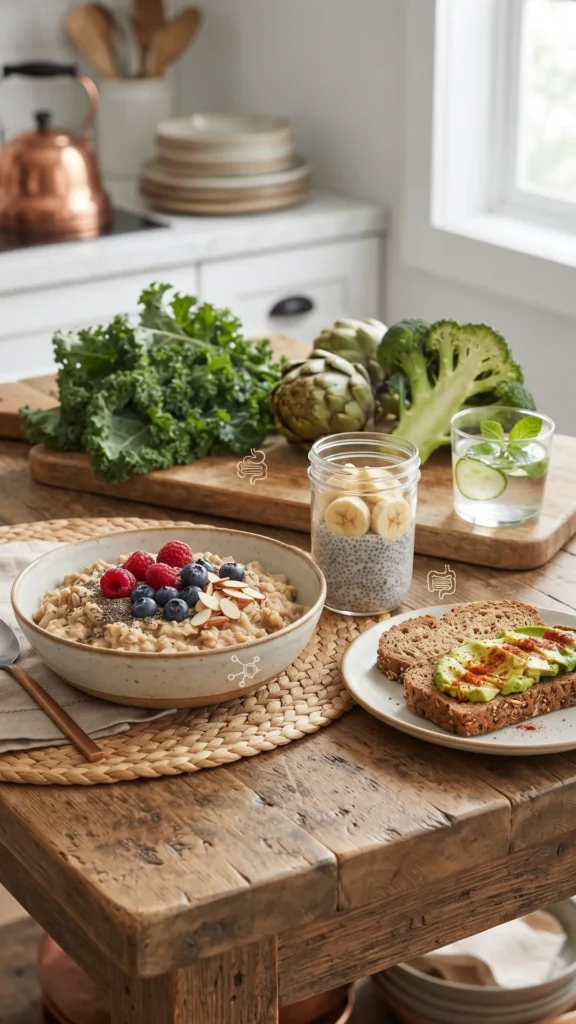
Overnight oats with chia seeds and berries are the most fiber-efficient breakfast available. Combining 40 grams of rolled oats with one tablespoon of chia seeds and a generous handful of raspberries or mixed berries provides approximately 15 grams of fiber for under 300 calories, over half the daily recommended fiber intake for most adults in a single breakfast serving.
Bran cereals, particularly wheat bran flakes and oat bran porridge, provide high fiber content per serving, though reading labels carefully is essential since many bran cereals also contain significant added sugar that partially undermines their nutritional benefit. Choosing unsweetened varieties or adding fruit for natural sweetness maintains the fiber benefit without the blood sugar impact of added sugar.
Whole grain toast with avocado provides approximately 5 to 7 grams of fiber per serving depending on the bread and avocado quantities. Smoothie bowls made with frozen berries and Greek yogurt and topped with chia seeds and oats provide 8 to 12 grams of fiber per large serving. Any breakfast that combines oats, berries, and seeds hits the highest fiber-per-calorie ratio achievable in a morning meal context.
Easy High-Fiber Snack Ideas for Between Meals
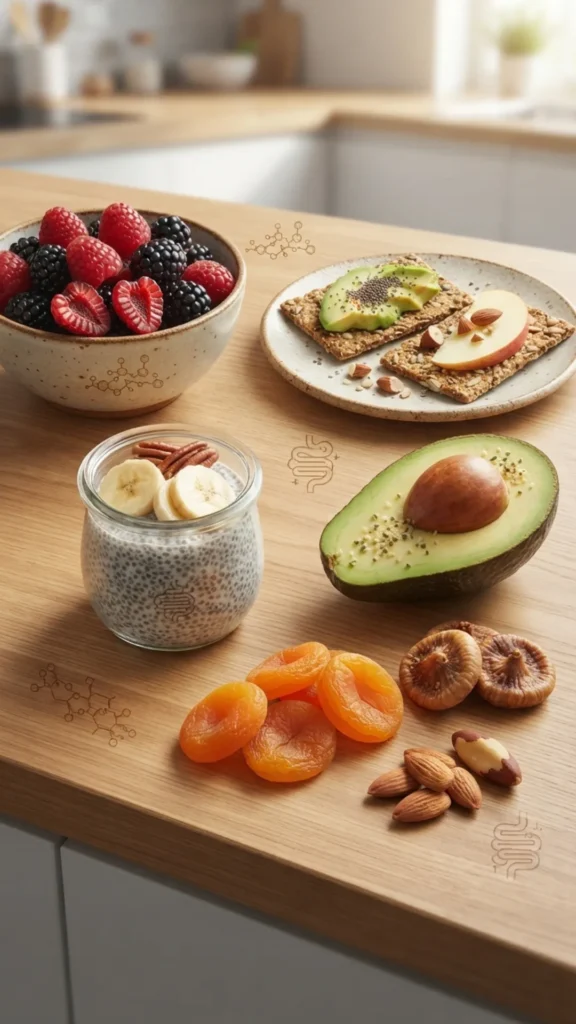
Snacks built around fiber-rich ingredients bridge the gap between meals while contributing meaningfully to daily fiber totals, which is considerably more nutritionally useful than snacking on fiber-free processed alternatives of similar calorie content.
A large bowl of raspberries or mixed berries, approximately 150 to 200 grams, provides 8 to 13 grams of fiber for 80 to 110 calories. Raw vegetables with hummus, a generous plate of carrot, celery, and bell pepper with two tablespoons of hummus, provides approximately 6 grams of fiber for 110 to 120 calories. A medium apple with skin eaten whole provides approximately 4 grams of fiber for around 80 calories.
A small bowl of edamame provides approximately 5 grams of fiber alongside 11 grams of protein per 100-gram serving, one of the best combined fiber and protein snack options available. Air-popped popcorn provides approximately 4 grams of fiber per 25-gram serving, one of the most volume-efficient fiber snacks available, filling a large bowl for approximately 100 calories with meaningful fiber contribution. Chia pudding prepared from two tablespoons of chia seeds in 150 ml of almond milk provides 10 grams of fiber per individual serving.
Soluble vs. Insoluble Fiber: Why Both Matter
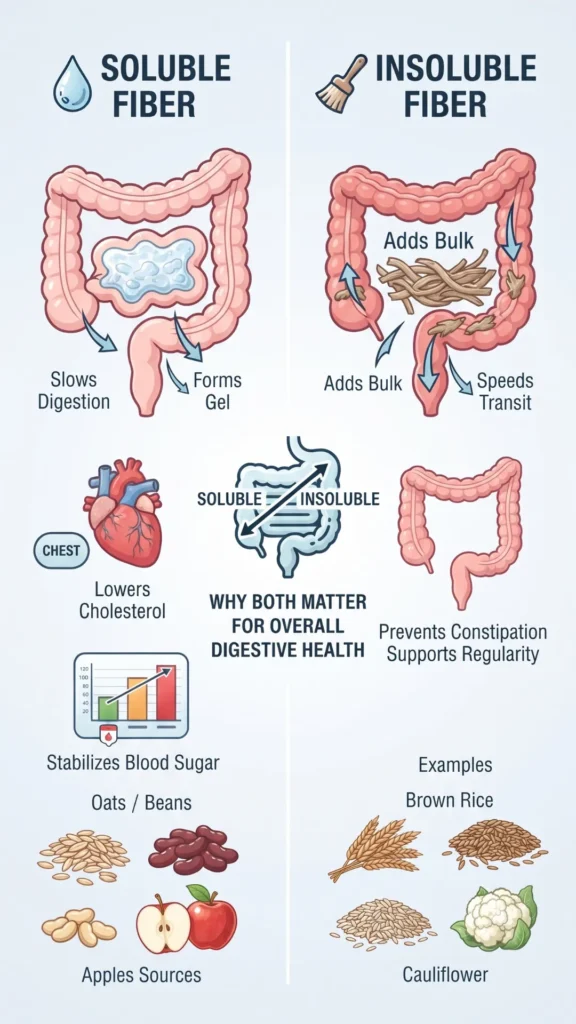
Understanding the difference between soluble and insoluble fiber clarifies why variety in fiber sources is more effective than relying on a single type and why the combination of different fiber-rich foods produces better health outcomes than maximizing one type alone.
Soluble fiber dissolves in Water to form a viscous gel in the digestive tract. This gel slows the rate at which the stomach empties, moderates glucose absorption into the bloodstream, and produces a gradual, sustained fullness that extends well beyond the meal. Foods particularly rich in soluble fiber include oats and barley, whose beta-glucan is the most studied soluble fiber, alongside legumes, apples, pears, citrus fruits, and flaxseeds. Soluble fiber also directly feeds beneficial gut bacteria and is the primary substrate for short-chain fatty acid production.
Insoluble fiber does not dissolve in Water. It adds bulk to digestive contents, absorbs Water, and promotes regular movement of food through the intestines, supporting gut health and regularity. Most vegetable skins, wheat bran, and the outer layers of whole grains are primary sources. The distinction matters practically: emphasizing only soluble fiber from oats while neglecting insoluble fiber from vegetables and whole grains produces incomplete fiber benefits. A diverse diet rich in both types, naturally achieved through eating a wide variety of whole plant foods, produces the full range of fiber’s health benefits.
Simple Ways to Add More Fiber Starting Today
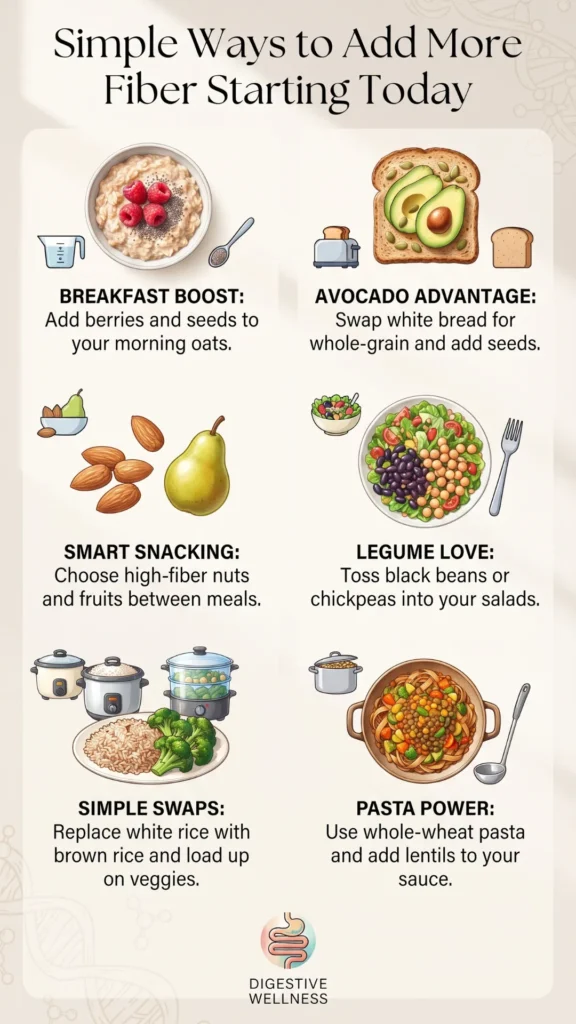
Increasing fiber intake does not require dramatic dietary change; it requires specific, stackable additions to existing meals that collectively move daily intake from the typical 12 to 15 grams toward the recommended 25 to 38 grams.
Add a tablespoon of chia seeds or ground flaxseed to any breakfast bowl, yogurt, or smoothie, invisibly increasing fiber by 2 to 10 grams per day from one addition. Swap white rice for brown rice or cauliflower rice at one meal per day, adding 1.8 grams of fiber per serving and increasing vegetable intake simultaneously. Add a half-cup of canned legumes to any soup, salad, or grain bowl, adding 5 to 8 grams of fiber from one ingredient addition.
Replace refined carbohydrate snacks with fruit or raw vegetable and hummus alternatives; the typical swap from a bag of crisps to a large bowl of berries and carrot sticks adds 7 to 10 grams of fiber while reducing calorie intake simultaneously. Start every main meal with a bowl of vegetable broth soup or a simple salad, adding 3 to 4 grams of fiber before the main plate begins.
Best Fiber Sources at a Glance: A Quick Comparison
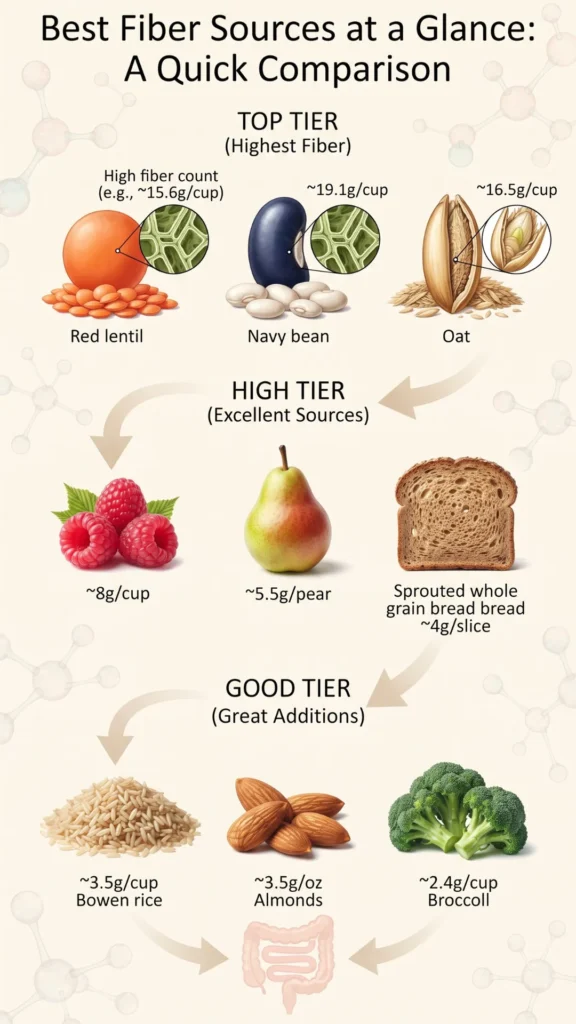
For easy reference when planning meals or shopping, here is a concise summary of the best fiber sources ranked by fiber content per typical serving:
Chia seeds, two tablespoons (10 g) fiber. Raspberries 150 g – 10 g fiber. Navy beans, half cup cooked – 9.5 g fiber. Lentils, half cup cooked – 8 g fiber. Black beans, half cup cooked, 7.5 g fiber. Artichoke, one medium 7 g fiber. Chickpeas, half cup cooked – 6 g fiber. Avocado, half medium – 5 g fiber. Pear, one medium with skin – 5.5 g fiber. Oats: 50 g dry 5 g fiber. Blackberries 100 g-5.3 g fiber. Brussels sprouts 100g – 3.8g fiber. Barley, half cup cooked – 3 g fiber. Apple, one medium with skin – 4.4 g fiber. Kiwi, two medium – 4 g fiber. Broccoli 150 g-4 g fiber. Almonds 30g – 3.5g fiber. Quinoa half cup cooked-2.8 g fiber. Ground flaxseed: one tablespoon (2 g fiber). Whole grain bread, one slice – 2 to 3 g fiber.
Building a day’s eating that draws from multiple categories on this list naturally produces daily fiber totals in the 30- to 40-gram range without requiring any deliberate tracking, which is exactly why a varied, whole-food diet consistently outperforms any single-food fiber supplement strategy.
Your Fiber Plan Starts at the Next Meal
The best fiber sources are not behind the health food counter or in the supplement aisle. They are in the fruit and vegetable section, the legume shelf, the grain aisle, and the dairy cooler of your regular weekly shop. Getting fiber right does not require a new shopping list; it requires knowing which items on your existing list to prioritize and which new ones to add.
Pick three additions from this guide that fit naturally into your current eating pattern. Add them to this week’s grocery list. Apply them consistently for two weeks and notice the difference in how full you feel, how stable your energy is, and how well your digestion functions. Those changes are fiber working exactly as it should.
Save this to your Pinterest board, so your complete fiber source guide is always within reach when you are planning meals or writing your shopping list. And for the volume-eating meal plans, high-fiber recipes, and complete food guides that show exactly how to apply these principles across a full eating day, everything you need is waiting at Volueat.com.
Disclaimer
This article is for informational purposes only and is not medical or nutritional advice. Always consult a healthcare professional before making significant changes to your diet, especially if you have existing health conditions
Table of contents
What Dietary Fiber Actually Is
How Much Fiber You Need Every Day
Beans and Legumes: The Most Fiber-Dense Foods Available
Lentils and Chickpeas: Everyday Fiber Champions
High-Fiber Fruits That Also Satisfy Sweet Cravings
Content
High-Fiber Vegetables That Add Volume and Nutrients
Leafy Greens and Cruciferous Vegetables for Daily Fiber
Whole Grains That Are Richest in Fiber
Nuts and Seeds as Concentrated Fiber Sources
High-Fiber Breakfast Foods That Start the Day Well
Easy High-Fiber Snack Ideas for Between Meals
Soluble vs. Insoluble Fiber: Why Both Matter
Simple Ways to Add More Fiber Starting Today
Best Fiber Sources at a Glance: A Quick Comparison
Your Fiber Plan Starts at the Next Meal