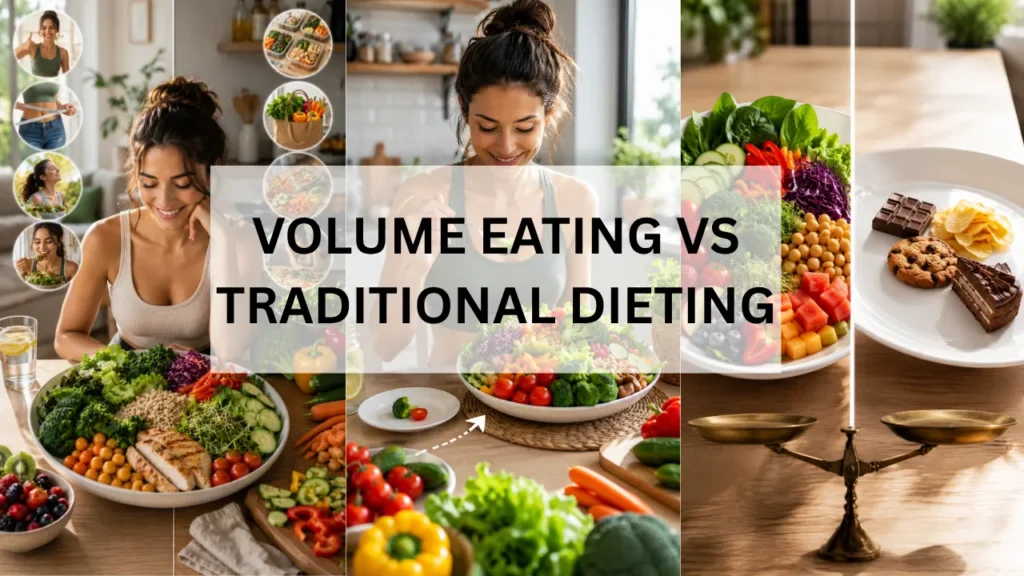
If you have ever tried a diet, stuck to it perfectly for two weeks, and then abandoned it because you were just too hungry to continue, you already understand the core problem with traditional dieting. The question is whether there is a better way. The real comparison here is not just volume eating vs. traditional dieting, but whether one approach is more likely to keep you full enough to stick with it.
This article breaks down both approaches honestly: how they work, where they struggle, and which one is more likely to actually stick over the long term. No hype, no overselling. Just a clear look at whether volume eating or traditional dieting offers the more sustainable path.

What Traditional Dieting Actually Looks Like
Traditional dieting is the approach most people default to when they decide to lose weight. It is built around the principle of calorie restriction, eating less than your body burns, creating a deficit that forces it to draw on stored fat for energy. In theory, it is straightforward. In practice, it is considerably more complicated.
Most traditional diets share a few common features. They define a daily calorie target, usually based on a fixed number, such as 1,200 or 1,500 calories. (Calorie counting made easy, 2024) They often restrict or eliminate specific food groups, carbohydrates, fats, sugar, or processed foods, depending on the diet. They tend to use portion control as the primary tool, meaning smaller amounts of familiar foods rather than different foods altogether.
Popular examples include calorie counting, low-carb and ketogenic diets, low-fat diets, meal replacement programs, and point-based systems like Weight Watchers. Each has a different mechanism, but they share the same foundational approach: reduce what goes in.
Traditional dieting has produced real results for many people, and it would be unfair to dismiss it entirely. Short-term weight loss on restrictive diets is well-documented. (Fernandes-Alves et al., 2025) The problem, as we will come to, is whether those results can last and why so many people end up back where they started.
Volume Eating Is and Why It Takes a Different Approach
Volume eating is a strategy built around calorie density rather than calorie counting. Instead of simply eating less food, the focus is on eating larger portions that are physically filling but low in calories. That difference in focus is what sets it apart from traditional restriction.
The approach is rooted in the work of Dr. Barbara Rolls at Penn State University, whose Volumetrics research showed that people tend to eat a consistent weight of food each day regardless of its calorie content. (Smith, 2024) When the food on your plate is heavy, water-rich, and fiber-dense, you eat a similar physical amount but consume significantly fewer calories without the sensation of eating less.
You might like: How Volume Eating Helps You Lose Weight Without Starving https://volueat.com/the-ultimate-guide-to-volume-eating-for-sustainable-weight-loss/
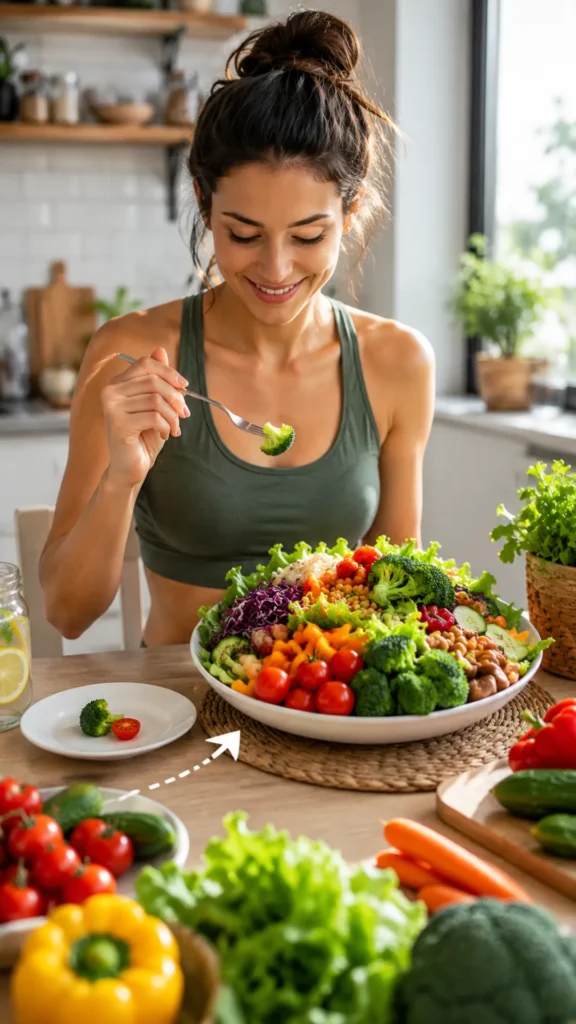
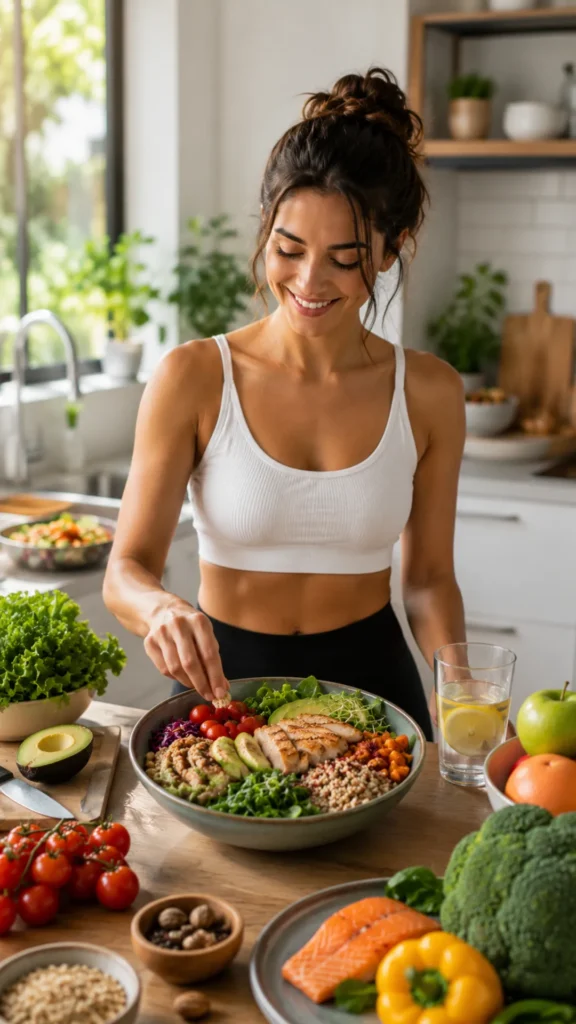
A volume-eating plate typically looks abundant. The foundation is made up of large portions of non-starchy vegetables, lean proteins, broth-based soups, fruits, and whole grains. Higher calorie-density foods are not banned; they are simply used in smaller quantities alongside the high-volume base.
For beginners, volume eating can feel almost counterintuitive. You are actively encouraged to fill your plate, eat until satisfied, and focus on what to add rather than what to remove. That shift in orientation is small on paper but significant in practice, particularly for anyone who has spent years associating dieting with deprivation.
How Hunger Quietly Destroys Weight Loss Progress
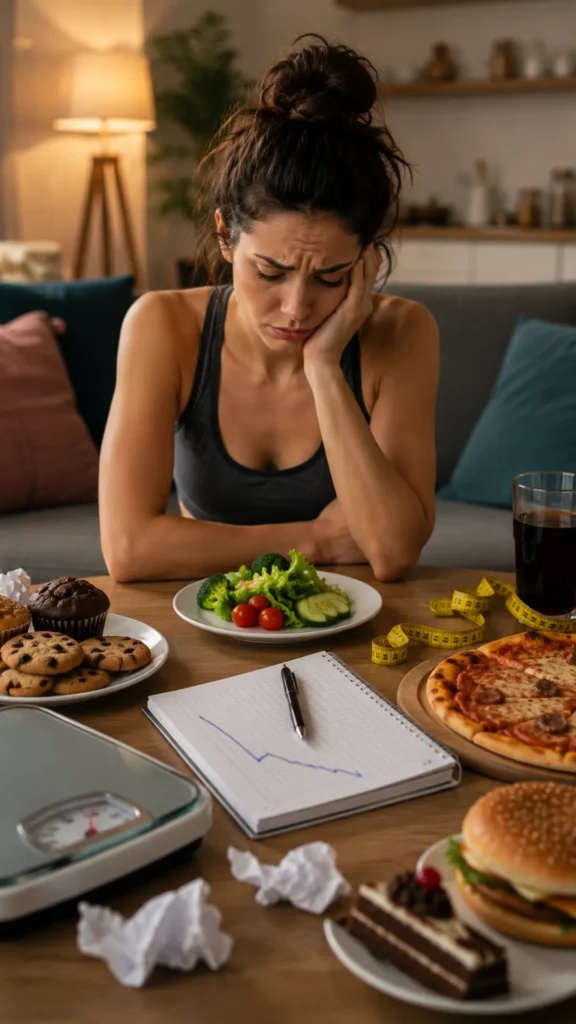
Hunger is the single biggest reason diets fail. Not lack of knowledge, not poor planning, not insufficient motivation or hunger. When you are physically hungry, your brain treats food as an urgent priority, and willpower becomes an increasingly unreliable tool against a biological drive that evolved over millions of years.
The hormonal mechanics make this clear. Ghrelin, the primary hunger hormone, increases when calorie intake drops significantly. Leptin, the fullness hormone produced by fat cells, decreases. The result is a double pressure: you feel hungrier than normal while simultaneously receiving weaker fullness signals after eating. The longer a restrictive diet continues, the more pronounced this hormonal shift becomes.
There is also a psychological dimension to chronic hunger that rarely gets discussed. Constant food preoccupation—thinking about what you can and cannot eat, planning your next meal, and resisting cravings is mentally exhausting. Over time, that cognitive load erodes the motivation that got the diet started in the first place. Most people do not quit diets because they stop caring. They quit because the mental and physical toll accumulates to a point where it outweighs the perceived benefit.
Hunger and weight loss are fundamentally at odds when the approach relies solely on restriction. Any successful long-term strategy needs to address hunger directly, not just hope that motivation outlasts it. That is precisely where volume eating offers a different answer to the same problem.
Calorie Density: The Concept That Changes Everything
Calorie density is the number of calories contained in each gram of food. It is the f (What Is Calorie Density and Why It Affects How Much You Eat, 2026)oundational concept behind volume eating, and understanding it changes how you look at every meal.
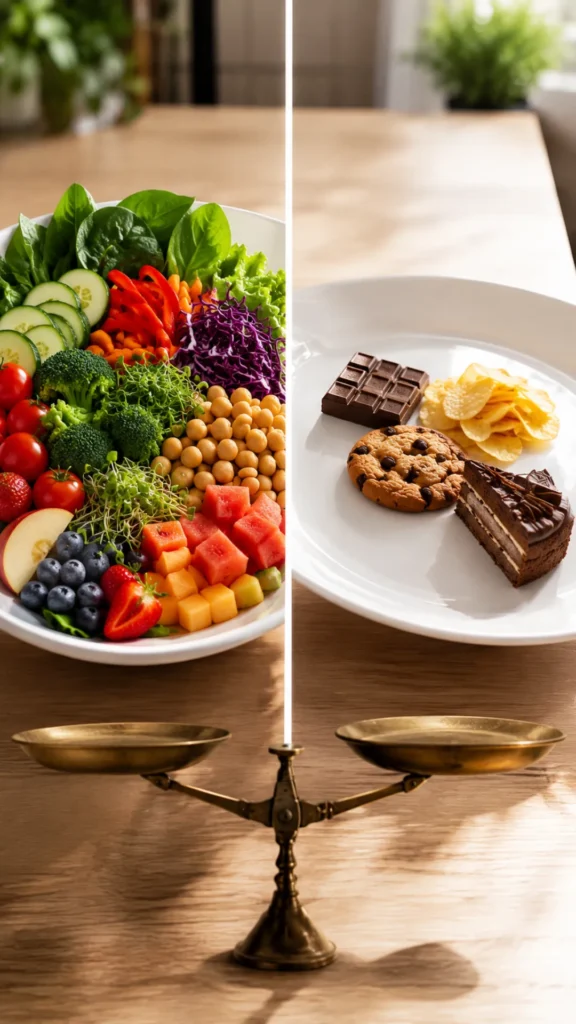
Foods at the low end of the calorie density scale, non-starchy vegetables, most fruits, and broth-based soups contain between 0.1 and 0.6 calories per gram. (Volumetrics Diet, Grokipedia, 2026) They are heavy, water-rich, and fiber-dense. You can eat a very large physical quantity of them for a modest calorie cost.
Foods at the high end, oils, butter, nuts, cheese, and processed snacks contain between 5 and 9 calories per gram. (FoodData Central, 2026) A small handful of cashews, for example, can contain 200 calories in a quantity that fits in your palm and disappears in thirty seconds. That same 200 calories in cucumber slices would fill a large dinner plate.
The middle of the spectrum is where most whole foods sit. Lean proteins like chicken breast and white fish have 0.7 to 1.2 calories per gram. Whole grains and legumes sit around 1.0 to 1.5. (FoodData Central, 2024) These are the foods that form the structure of volume-eating meals alongside the low-density vegetable and fruit base.
Traditional dieting does not typically account for calorie density; it focuses on total calories regardless of how physically filling those calories are. Two diets with the same calorie target can produce very different experiences of hunger depending on how that calorie budget is distributed across the density spectrum. Deliberate volume eating leverages this understanding, making fullness the deciding factor in how those calories are used.
Why Traditional Diets So Often End in Failure
The failure rate of traditional dieting is not a secret. Research consistently shows that the majority of people who lose weight on a restrictive diet regain most or all of it within two to five years. (Busetto et al., 2021) Understanding why this happens is essential for anyone seeking a genuinely better alternative.
The first reason is metabolic adaptation. When calorie intake drops significantly, the body adapts by reducing its metabolic rate, burning fewer calories at rest to conserve energy. This is sometimes called metabolic slowdown, and it means that the same calorie intake that produced a deficit in week one may no longer do so by week twelve. (Forslund et al., 2023) The deficit narrows over time even when the diet remains unchanged.
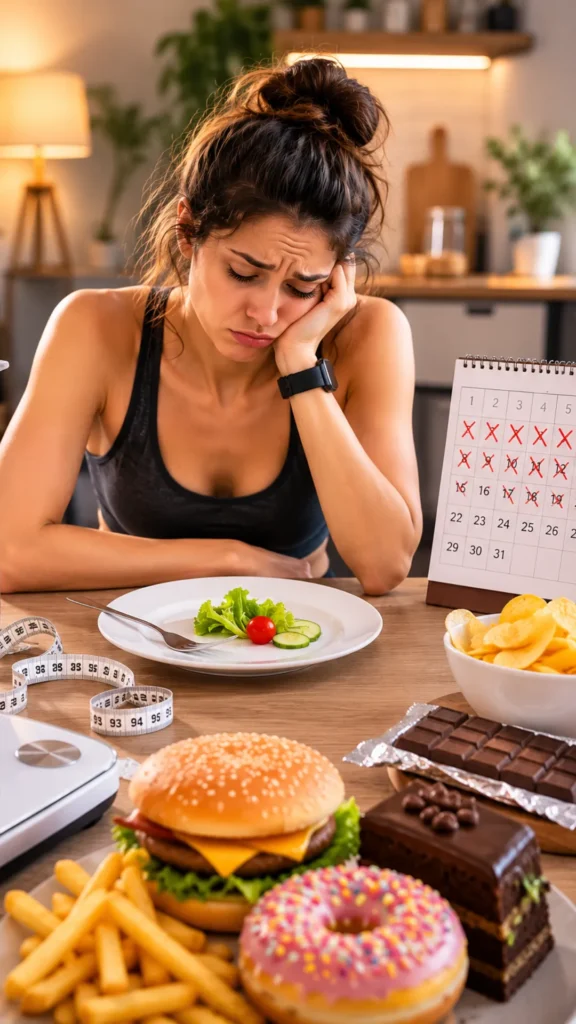
The second reason is dietary fatigue. Restrictive dieting effects accumulate. Eating the same small portions of the same limited foods day after day is psychologically draining in a way that is hard to appreciate until you are living it. Eventually, most people reach a point where the restriction simply feels unsustainable, and they return to previous eating patterns, often with a rebound effect.
The third reason is the all-or-nothing mindset that rigid diets tend to create. When food is divided into allowed and forbidden categories, a single slip, eating a piece of cake at a birthday party, for instance, can trigger the sense that the diet is ruined and lead to full abandonment. This fragility is a structural problem with restriction-based approaches.
Why traditional diets do not work long-term is not primarily a matter of the diet being wrong in theory. A calorie deficit does produce weight loss. The problem is that creating that deficit through restriction is not an experience most people can sustain indefinitely, and sustainability is the real test of whether a diet works.
How Volume Eating Keeps You Full and in Control
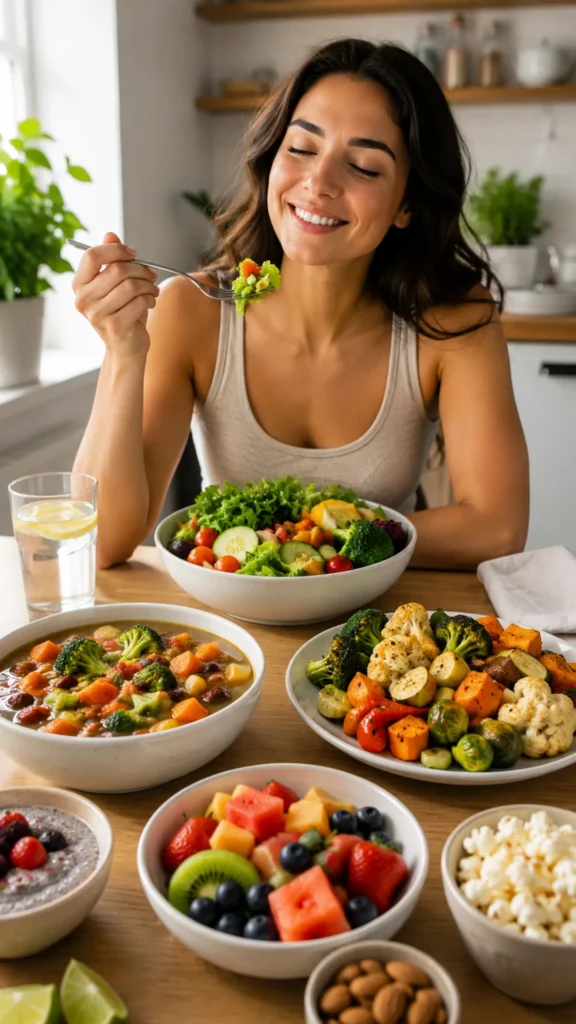
Volume eating addresses hunger at its source rather than relying on willpower to bridge the gap. By filling the stomach with water-rich, fiber-dense food, it activates the stretch receptors in the stomach wall that send genuine fullness signals to the brain. The deficit is real, but the experience of eating stays aligned with the goal.
Protein plays an essential role alongside volume. Lean proteins trigger the release of satiety hormones cholecystokinin and peptide YY that communicate fullness through a different pathway from the physical stretch response. (Ignot-Gutiérrez et al., 2024) Combining high vegetable volume with solid lean protein at every meal produces a fullness that is both immediate and lasting, typically three to four hours without meaningful hunger returning. (Ajmera, 2026)
Broth-based soups are among the most effective tools in the volume-eating toolkit. A large bowl of vegetable soup can contain as few as 60 to 80 calories while occupying significant stomach space. Research shows consistently that eating soup before a main meal reduces total calorie intake at that meal without reducing the sense of having eaten enough. (Rolls, 2017, pp. 246-253) From there, the next step is to see how this approach translates into everyday meal building.
The fiber contribution from vegetables, fruits, legumes, and whole grains also stabilizes blood sugar throughout the day. Without the sharp glucose spikes and crashes of refined carbohydrate eating, energy stays steady, and the urgent, craving-driven hunger that derails so many diets simply does not develop in the same way. Appetite control for weight loss becomes far less effortful when blood sugar is stable.
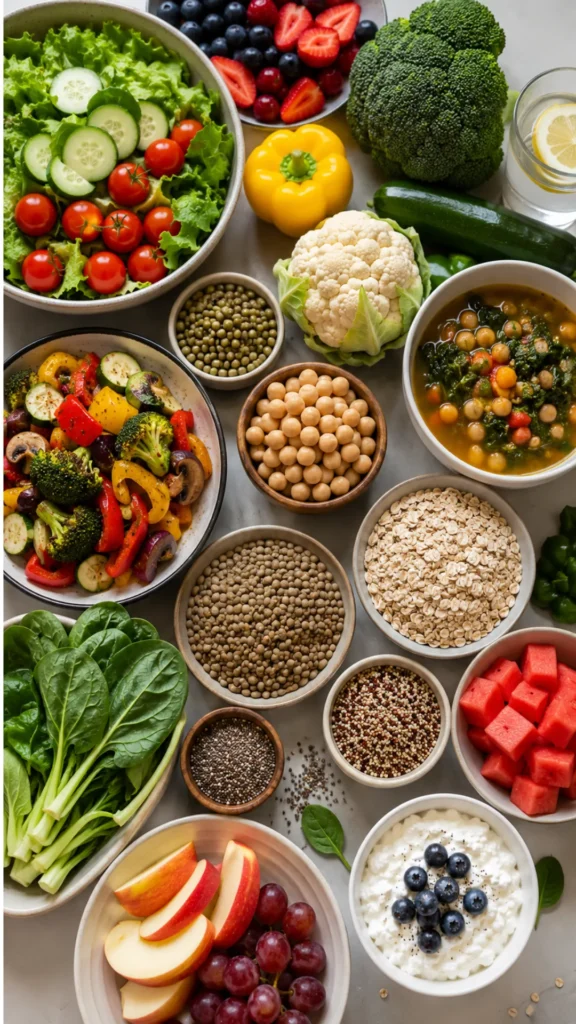
The Foods That Make Volume Eating Work
Building volume by eating meals effectively comes down to knowing which foods belong at the center of the plate and which ones play a supporting role.
Non-starchy vegetables are the foundation. Cucumber, zucchini, spinach, romaine lettuce, broccoli, cauliflower, cabbage, celery, mushrooms, and bell peppers are all exceptional choices. Most sit below 35 calories per 100 grams, which means large portions can be built without meaningful calorie cost. (Calorie Density: How to Lose Weight Eating More Food, 2023) Roasting them with seasoning, throwing them into stir-fries cooked in broth, or eating them raw all work well.
Lean proteins are the anchor. Egg whites, skinless chicken breast, white fish like cod or tilapia, shrimp, nonfat Greek yogurt, and low-fat cottage cheese all provide strong satiety with relatively modest calorie contributions. Plant-based options include lentils, chickpeas, black beans, tofu, and edamame, all of which combine protein with meaningful fiber.
Fruits sit in the middle tier. Watermelon, strawberries, raspberries, cantaloupe, and grapefruit are all high in water content and deliver sweetness and physical volume without heavy calorie investment. They work well as snacks, breakfast additions, and dessert alternatives.
Whole grains, oats, barley, brown rice, and quinoa complete the plate. They are more calorie-dense than vegetables but significantly more filling than refined carbohydrates. Oats are particularly effective for breakfast, thanks to their beta-glucan fiber, which suppresses appetite for hours. (Shehzad et al., 2023)
Low-calorie filling foods like broth-based soups, herbal teas, and sparkling water are underappreciated volume-eating tools. They add liquid volume, warmth, and satisfaction between meals without adding meaningful calories.
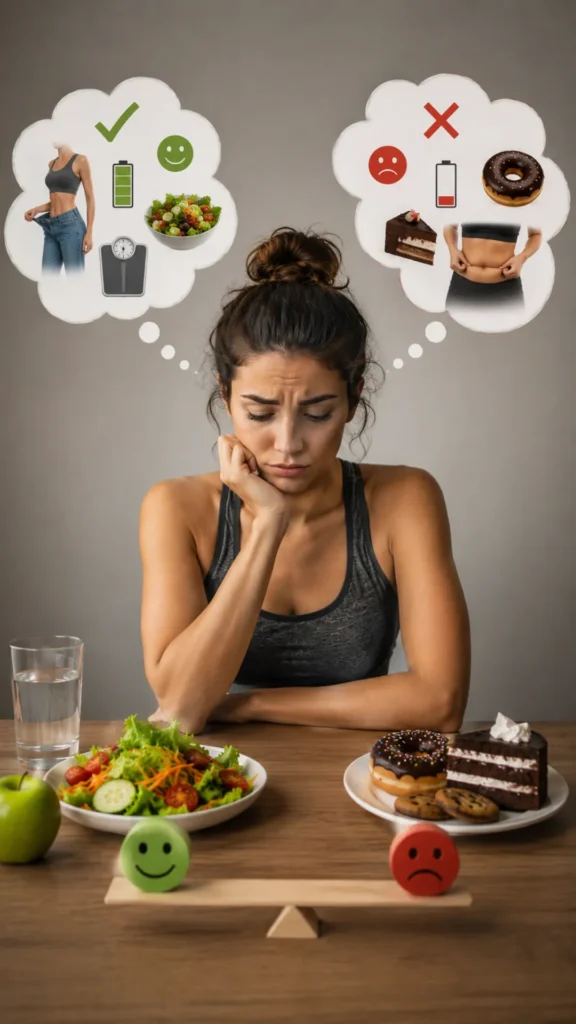
The Honest Pros and Cons of Traditional Dieting
Traditional dieting has genuine strengths alongside its well-documented weaknesses. Acknowledging both is more useful than simply dismissing it.
On the positive side, the structure of calorie counting and portion control works well for people who find clear rules easier to follow than flexible guidelines. Traditional dieting also produces rapid initial weight loss, which can be motivating in the short term. Many people find that the discipline of tracking food intake builds awareness of what they eat, a change that carries forward even after formal tracking ends.
On the negative side, the hunger it generates is its most significant and consistent problem. Restrictive dieting effects on hunger hormones are real and measurable, and they work directly against the goal of sustained adherence. The all-or-nothing mindset it tends to create is fragile. Metabolic adaptation reduces its effectiveness over time. And the psychological burden of constant restriction can erode motivation more reliably than almost any other factor.
It is also worth noting that many traditional diet approaches are nutritionally incomplete, particularly very low-calorie or extreme low-carb protocols, which can lead to nutrient deficiencies over time and create their own hunger signals as the body searches for missing micronutrients.
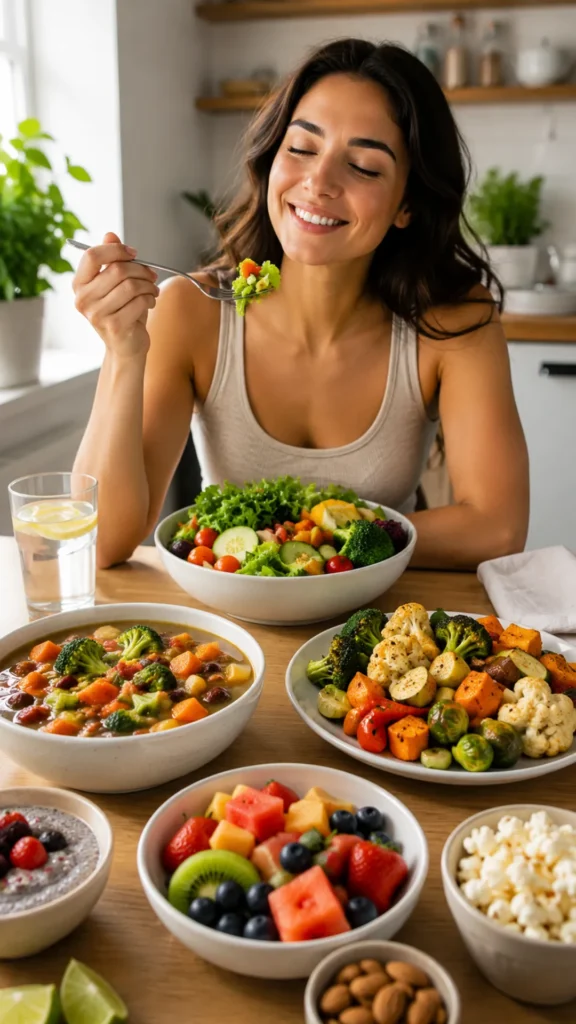
The Honest Pros and Cons of Volume Eating
Volume eating is not without its challenges either, and presenting it as a perfect solution would be misleading.
The strengths are significant. Hunger management is genuinely better the physical fullness from high-volume meals is not a trick or a placebo effect; it is a physiological reality. The approach naturally improves overall diet quality, since high-volume foods are almost universally nutrient-rich. It is flexible and adaptable to almost any dietary preference or cultural food tradition. And it creates a positive, abundance-oriented relationship with food that most restrictive diets cannot offer.
The challenges are real too. For people who do not enjoy vegetables or find them difficult to prepare in appealing ways, building the foundation of volume eating is harder. The approach requires more cooking and meal preparation than many convenience-oriented traditional diets. Progress may feel slower initially than the rapid first-week loss on a very low-calorie diet, which can be discouraging for people accustomed to fast results.
Volume eating also requires a shift in mindset that takes time to develop. Learning to see vegetables as the main event rather than the side dish, to cook with broth instead of oil, and to start meals with soup or salad rather than diving straight into the main course—these are habits that develop over weeks, not overnight.
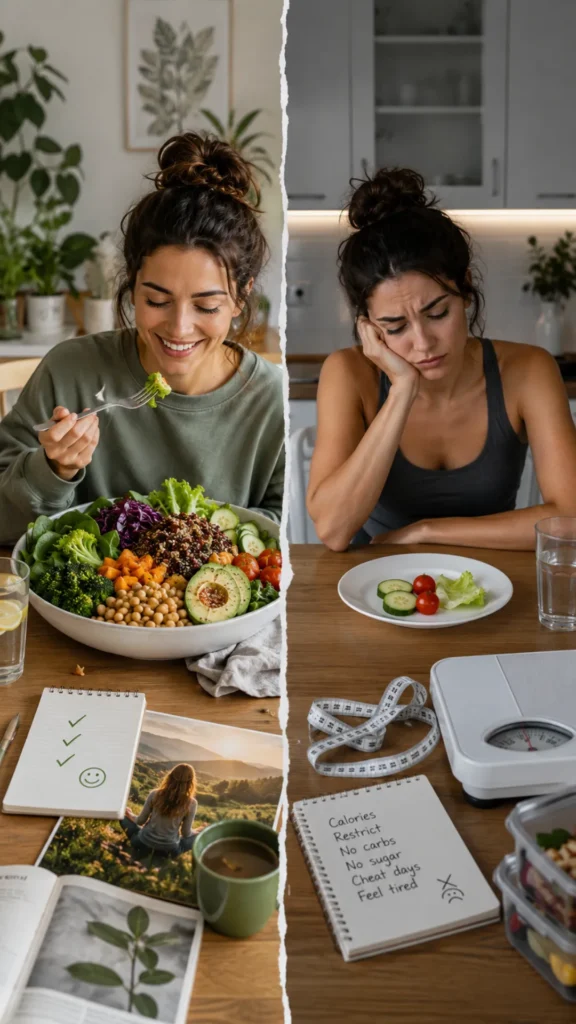
Which Approach Is Genuinely Easier to Maintain
Sustainability is the only metric that matters for long-term weight loss. A diet that produces dramatic short-term results but cannot be maintained produces no lasting benefit. Measured against that standard, volume eating has a clear and meaningful advantage.
The reason is simple: volume eating does not require fighting hunger indefinitely. The deficit is real, but the experience of eating is satisfying rather than depleting. Meals feel like meals. Portions look generous. The psychological experience of the diet is fundamentally different from that of restriction-based approaches, and that difference accumulates into better long-term adherence.
Traditional dieting can be maintained long-term by some people, particularly those who find rigid structure helpful and who have a strong tolerance for hunger. But for the majority, the combination of physical hunger, hormonal pressure, dietary fatigue, and the all-or-nothing mindset creates a cycle of short-term success and longer-term regression that is difficult to break without changing the approach itself.
Sustainable eating habits are built on consistency, not perfection. Volume eating lends itself to consistency because the baseline behavior of filling your plate with vegetables, including lean protein, starting with soup, is repeatable and enjoyable in a way that eating half portions of everything simply is not.

Real-Life Results and What Sustained Success Actually Looks Like
The most compelling evidence for volume eating comes not just from clinical research but from the experience of people who have tried both approaches. A common pattern emerges in volume eating success stories: people describe the shift from restriction-based dieting to volume eating as fundamentally changing their experience of trying to lose weight.
The most frequently reported change is the absence of constant food preoccupation. When meals are physically satisfying, the mental noise around food the cravings, the bargaining, the guilt reduces significantly. Eating becomes less of a battleground and more of a practical, enjoyable part of the day.
Weight loss on volume eating tends to be steadier and slower than the initial loss on a very low-calorie diet but more consistent over time. Without the hormonal disruption of severe restriction and without the rebound eating that follows restriction cycles, the trajectory tends to be more linear and more durable.
Long-term fat loss strategies all share one characteristic: they must be sustainable by definition. Any approach that cannot be maintained beyond a few weeks cannot produce long-term results, regardless of how effective it is in the short term. By that measure, volume eating is not just a good option for most people; it is the better one.
The Verdict: Your Next Meal Can Settle
Both approaches can produce weight loss. That much is true. But volume eating vs. traditional dieting is ultimately a question of which experience you can actually live with long enough for the results to last, and on that question, the evidence points consistently in one direction.
If you have tried restriction-based dieting and found yourself quitting because of hunger, that is not a personal failure. It is a predictable response to an approach that pits biology against willpower. Volume eating removes that opposition entirely, and the difference in experience is something most people notice within the first week.
Start with one meal today. Fill half your plate with non-starchy vegetables before anything else goes on it. Add a lean protein. Begin with broth if you have it. That is not a diet. That is just eating well, and it is a habit you can keep for life. Save this to your Pinterest board and come back to it when you are planning your next grocery run. The Volueat.com food guides and meal ideas are ready whenever you are
Disclaimer
This article is for informational purposes only and is not medical or nutritional advice. Always consult a healthcare professional before making significant changes to your diet, especially if you have existing health conditions
Table of Content
What Traditional Dieting Actually Looks Like
What Volume Eating Is and Why It Takes a Different Approach
How Hunger Quietly Destroys Weight Loss Progress
Calorie Density: The Concept That Changes Everything
Why Traditional Diets So Often End in Failure
How Volume Eating Keeps You Full and in Control
The Foods That Make Volume Eating Work
The Honest Pros and Cons of Traditional Dieting
The Honest Pros and Cons of Volume Eating
Which Approach Is Genuinely Easier to Maintain
Real-Life Results and What Sustained Success Actually Looks Like
The Verdict: Your Next Meal Can Settle