
The reason most people struggle with healthy eating is not knowledge; it is structure. Without a plan, every meal becomes a fresh decision made under time pressure or hunger, and those decisions rarely produce the results you are working toward. Healthy meal plans for results change that entirely by turning good eating from a series of willpower moments into a simple, repeatable system. The plan does the thinking. You do the eating. Learn about Meal plans, recipes, grocery lists, and challenges. Gives them results.
This guide gives you everything: a practical framework for building weekly meal plans, easy recipes for every meal, a smart grocery list, and the habits that turn short-term eating changes into long-term results. Whether you are planning for the first time or looking to make your current approach more effective, this is your complete resource.

Why Healthy Meal Plans for Results Actually Work
You might lile this: https://volueat.com/wp-admin/post.php?post=1225&action=edit
Structure is the variable that most determines whether healthy eating produces results or stays a good intention. A healthy meal plan removes the daily decision-making that drives poor food choices, the late-afternoon “What am I making for dinner?” uncertainty, the too-tired-to-cook Tuesday that ends in takeaway, and the unprepared Thursday that produces whatever is easiest rather than whatever is best.
Research on meal planning and dietary adherence consistently shows that people who plan their meals in advance consume fewer calories, eat more vegetables and protein, and maintain their dietary approach for longer than people who eat reactively. The plan itself does not produce the result; the consistency that the plan enables does.
A well-structured meal plan also reduces grocery spending, reduces food waste, and reduces the mental load of daily food decisions, which is a meaningful benefit in itself. The ten minutes spent planning the week’s meals on Sunday returns significantly more than ten minutes of better eating throughout the following week.
The most effective meal plans are flexible rather than rigid. They provide structure without demanding perfect compliance. A plan that accommodates a spontaneous restaurant meal, an unexpected busy evening, and a leftover lunch is a plan that can actually be followed. A plan that requires flawless execution produces guilt when life intervenes, and guilt is the emotion most reliably associated with abandoning dietary approaches entirely.

How to Build a Simple Weekly Meal Plan That You Will Actually Follow
The most sustainable weekly meal plan is built on a template rather than a rigid daily schedule. A template defines the structure of each meal, what types of food appear, in what proportions, and at what calorie range, without specifying the exact dish for every day of the week. This flexibility allows the plan to accommodate preferences, availability, and energy levels without collapsing when a single element changes.
For healthy meal plans for results, the template for every main meal follows this structure: half the plate non-starchy vegetables, a quarter lean protein, a quarter fiber-rich carbohydrate or legume, and a broth-based soup or simple salad started before the main plate. Breakfast follows a separate but equally consistent template: protein plus fiber plus natural sweetness from fruit, in a format that requires minimal morning preparation.
Planning three to four distinct dinners and doubling the portions for next-day lunches reduces the number of unique meals to plan and prepare from fourteen to six or seven, a manageable weekly cooking load. Breakfast rotates between two or three consistent options that require minimal preparation. Snacks are planned from a standing list of approved options rather than decided spontaneously.
Writing the plan on Sunday, five to ten minutes reviewing what proteins, vegetables, and grains are needed and building a grocery list from the plan , creates the shopping structure that makes the plan executable. The plan cannot be followed if the right ingredients are not in the house. The list ensures they are.

Healthy Meal Plans for Results Start With These Breakfast Ideas
Breakfast is the meal that most determines how hungry you feel, how stable your energy is, and how well your food choices hold up across the rest of the day. A breakfast that provides adequate protein and fiber sets a lower hunger trajectory for the entire day. A breakfast that does not have refined carbohydrates, sugary cereal, or white toast with jam produces blood sugar instability that drives cravings and overeating by mid-morning.
Overnight oats with Greek yogurt and berries is the most practical high-protein, high-fiber breakfast for a result-focused meal plan. Prepared the night before in individual jars , 40 grams of rolled oats, one tablespoon of chia seeds, 100 grams of non-fat Greek yogurt, and a large handful of frozen berries,it requires no morning effort and provides approximately 270 to 290 calories with 16 grams of protein and 9 grams of fiber. Preparing five jars on Sunday covers every weekday breakfast in ten minutes.
Egg white scrambles with vegetables are the best savory breakfast option. Four egg whites scrambled with one whole egg, cooked in vegetable broth with a generous pile of spinach, mushrooms, and bell pepper, produces a visually substantial, genuinely filling breakfast for under 200 calories with 18 to 20 grams of protein. Adding a slice of whole grain toast keeps the total under 280 calories while adding fiber and satisfying the texture of a complete morning meal.
A Greek yogurt parfait layered with oats, fresh fruit, and a tablespoon of ground flaxseed provides variety within the same nutritional framework: high protein, high fiber, natural sweetness, and preparation that takes under three minutes. Rotating between these three breakfast options prevents the monotony that causes people to abandon structured eating plans.

Filling Healthy Lunch Ideas That Make Meal Plans Sustainable
Lunch on a result-focused meal plan should be substantial enough to carry through to the afternoon without snacking, portable enough to work at any location, and practical enough to be prepared the night before or assembled quickly from meal-prepped components.
The giant protein salad is the most flexible and most effective lunch format for healthy meal plans. A very large base of romaine and spinach, enough to fill a large container generously, loaded with cucumber, cherry tomatoes, shredded cabbage, celery, and bell pepper, topped with a lean protein, and dressed with lemon juice and a teaspoon of olive oil, provides a filling, nutritionally complete lunch for 280 to 380 calories depending on the protein chosen.
Red lentil and vegetable soup prepared in a large batch on the weekend provides five to six individual lunch portions with minimal daily effort. A 350-milliliter portion reheated in three minutes provides 300 to 350 calories with 18 grams of protein and 14 grams of fiber, one of the most filling lunches available for its calorie investment. Having two to three containers of this soup in the fridge at all times provides reliable lunch coverage across the week without any daily preparation.
Grain bowls built from prepped components, brown rice or quinoa, roasted vegetables, and a protein, assembled in individual containers, take four minutes to put together and keep well in the fridge for three to four days. The components are already prepared from the weekend session. Assembly is the only daily effort required.

Simple Dinner Recipes That Deliver Real Weight Loss Results
Dinner on a healthy meal plan should feel like a proper meal ,satisfying, flavorful, and substantial enough that the evening hours are comfortable rather than characterized by snacking and grazing from ongoing hunger.
Baked white fish with roasted broccoli, cauliflower, and a cauliflower rice base is the foundational volume-eating dinner that appears in every effective healthy meal plan for results. A 180-gram fillet of cod or tilapia baked with lemon and herbs alongside 300 grams of roasted mixed vegetables and a generous portion of cauliflower rice, started with a bowl of miso soup, produces a dinner for 350 to 400 calories with 38 to 40 grams of protein and exceptional physical volume.
Red lentil dal with spinach and canned tomatoes served over brown rice is the plant-based equivalent, warming, deeply satisfying, inexpensive, and improved with reheating, making it the ideal batch-cooking dinner. A large pot provides five to six portions at 420 to 450 calories each with 20 grams of protein and 14 grams of fiber. Two cooking sessions per week at dinnertime cover both warm plant-based lunches and dinners for the following day.
Chicken and vegetable stir-fry over cauliflower rice, one-pan baked chicken with roasted vegetables, turkey mince stir-fry with broccoli and brown rice, and shrimp and bok choy stir-fry in ginger broth complete a practical rotation of five dinner options that covers the full week with variety and minimal repetition.

Healthy Snacks to Build Into Every Meal Plan
Planned snacks are the element most commonly missing from meal plans that fail, and their absence is usually the reason. When snacks are not planned, mid-meal hunger is addressed with whatever is nearest, which in most environments means processed, calorie-dense options that undermine the meals surrounding them.
Non-fat Greek yogurt with fresh or frozen berries is the most reliable planned snack for healthy meal plans, approximately 130 calories with 15 grams of protein, prepared in thirty seconds, and immediately available from the fridge. Hard-boiled eggs prepared at the start of the week provide a portable, zero-preparation protein snack of approximately 140 calories per two-egg serving.
Raw vegetable sticks with hummus, cucumber, celery, carrot, and bell pepper with two tablespoons of hummus provide crunch, fiber, and protein for 100 to 120 calories. A large bowl of watermelon or mixed berries provides sweet satisfaction and physical volume for 60 to 100 calories. Edamame, salted and portioned into individual bags, provides 11 grams of protein and 5 grams of fiber per 100-gram serving at 122 calories.
The practical rule for snack planning is to prepare two snacks at the start of each day, one mid-morning and one mid-afternoon. The most accessible option is the structural change that makes planned snacking automatic.

How to Create a Smart Grocery List for Your Meal Plan
A grocery list that directly reflects the weekly meal plan is the structural bridge between planning and execution. Without the right ingredients in the house, even the best plan cannot be followed. With them, following the plan becomes the easiest available option.
The most effective grocery list for healthy meal plans is organized by category: proteins, vegetables, fruits, whole grains, and and pantry staples , and covers exactly what is needed for the specific week’s planned meals plus the standing snack staples. This prevents both over-purchasing items that go to waste and under-purchasing items that leave meals incomplete.
For a typical week of volume eating meal planning, the list includes one large pack of chicken breast or white fish fillets, five to six cans of tuna in water, one dozen eggs, two large tubs of non-fat Greek yogurt, one bag of dried red lentils, two cans of chickpeas, large bags of spinach and romaine, broccoli, cauliflower, zucchini, cucumber, celery, bell peppers, cherry tomatoes, mushrooms, large bags of frozen mixed berries, four to six apples, rolled oats, brown rice or quinoa, canned chopped tomatoes, vegetable broth, miso paste, chia seeds, lemon juice, herbs, and spices.
Shopping this list from the outer aisles of the supermarket first, produce, meat, fish, dairy , naturally fill the cart with the right foods before the center aisles are reached. This shopping pattern makes volume eating the structural default rather than requiring active resistance to processed food aisles.

Essential Foods to Keep Stocked for Consistent Healthy Eating
Beyond the weekly shop, certain staples keep the plan running even when the fresh shopping has not happened recently or the week has been more demanding than usual. These are the ingredients worth maintaining at all times.
Canned tuna in water, canned chickpeas, canned black beans, and dried red lentils require no refrigeration and no advance preparation and provide complete protein and fiber additions to any improvised meal. Canned chopped tomatoes and vegetable broth form the base of soups, stews, and sauces that can be assembled in twenty minutes from the pantry alone. Rolled oats, chia seeds, and ground flaxseed mean breakfast is always available regardless of what the fridge contains.
Frozen vegetables , broccoli, cauliflower, spinach, and mixed vegetables , nutritionally equivalent to fresh and significantly more durable, providing volume-eating vegetable components for any meal when fresh produce has run low. Frozen berries mean breakfast and snack fruit is always available. Frozen white fish fillets and frozen shrimp provide protein options for any dinner without requiring advance fresh shopping.
These twelve staple categories, together representing less than thirty minutes of shopping time and a modest weekly cost , provide the nutritional insurance that makes healthy meal plans for results work across weeks when life does not go exactly to plan.
Meal Prep Tips That Make the Whole Plan Work
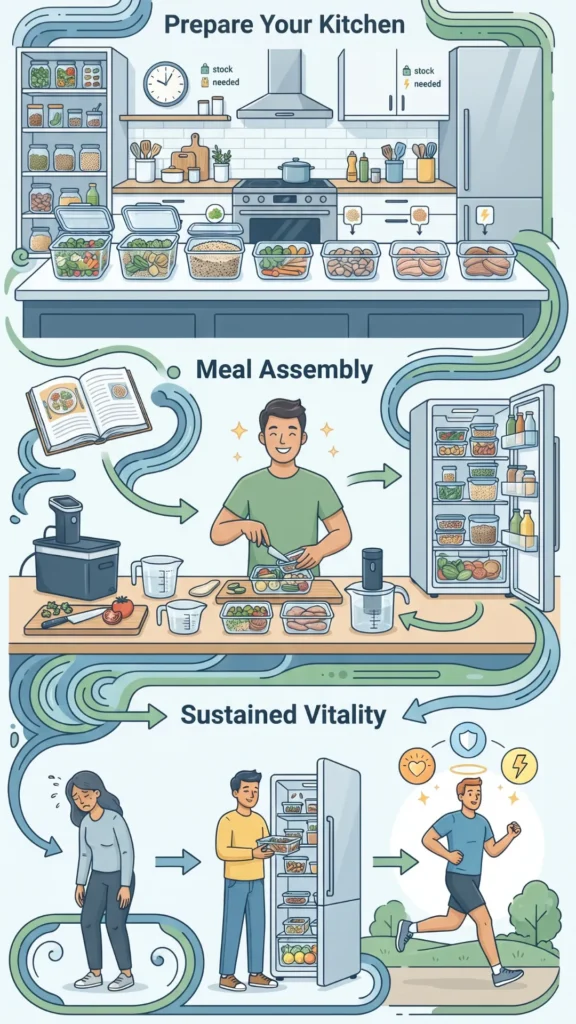
Meal prep is the execution engine of any effective healthy meal plan. Without it, the plan exists on paper but collapses in practice when daily time and energy are insufficient for fresh cooking at every meal.
The most efficient prep session covers five components: batch-cooking one or two proteins, cooking a large grain batch, roasting two trays of vegetables, preparing five overnight oat jars, and washing and portioning raw vegetables for salads and snacking. This session takes approximately ninety minutes on Sunday and provides the building blocks for every main meal and snack across the week.
Labeling containers with preparation dates removes the uncertainty about what is still good , and prevents both throwing away perfectly edible food and eating food stored too long. Storing prepped food at eye level in the fridge rather than pushed to the back means it is reached for first when hunger or meal time arrives. Visible, accessible food is food that gets eaten.
Batch cooking double portions of dinners for next-day lunch dramatically reduces the total number of cooking sessions required across the week. Making a large pot of lentil soup on Monday evening provides four to five lunch portions with zero additional cooking. The leverage this produces, one cooking session covering multiple meals, is the most time-efficient meal prep strategy available.

How Healthy Eating Challenges Build Better Habits
A structured healthy eating challenge, whether a seven-day plan, a thirty-day commitment, or a specific one-habit-per-week challenge , provides the time-bounded focus and daily structure that many people find useful for establishing new eating patterns before they become habitual.
Challenges work for habit formation because they provide a defined context, a beginning, a daily structure, and an endpoint , that creates both commitment and accountability. The volume-eating seven-day challenge, for example, introduces the plate structure, the pre-meal soup habit, and the protein-at-every-meal principle across a single week of structured daily meals. By the end of seven days, most people have experienced the approach enough to understand why it works, which is the motivation to continue beyond the challenge.
The most durable challenges are those with specific, daily process goals rather than outcome goals. Track whether you started each main meal with broth or salad, whether each meal included a clear protein source, and whether the plate was at least half vegetables, rather than tracking the number on the scale. Process adherence produces outcome results. Focusing on the process prevents the discouragement that scale fluctuations produce in the early weeks.
Common Meal Planning Mistakes That Slow Down Results
Planning too many different meals for the week is the most common mistake beginners make. Seven completely different dinners, seven different lunches, and seven different breakfasts create a shopping list and prep load that is unsustainable for most real schedules. Three to four dinner options with planned leftovers, two to three breakfast rotations, and a consistent lunch format are the practical, sustainable structure.
Planning without a corresponding grocery list means the plan exists without the ingredients to execute it. The plan and the list are one document; the list is derived directly from the plan, and both are created together. A plan without a list is wishful thinking. A plan with a list is an executable system.
Allowing no flexibility produces all-or-nothing thinking when plans change. Building one flexible meal into the week, a designated evening where the structure applies loosely or where a restaurant meal fits ,prevents the psychological collapse that treats any deviation as a failure. Flexibility built into the plan is more sustainable than flexibility forced by circumstances.

How Healthy Meal Plans for Results Become Long-Term Habits
The transition from following a meal plan to simply eating well happens gradually over six to eight weeks of consistent application. The weekly plan becomes automatic. The grocery list becomes intuitive. The plate structure becomes habitual. The preparation becomes the default Sunday activity rather than a deliberate effort.
At that point, the meal plan has done its job, not by producing temporary results but by building the habits, preferences, and routines that make those results permanent. The meals that once required planning now require almost no conscious thought. The foods that once seemed like a compromise have become genuinely preferred. The eating pattern that produced the results has become the way you eat.
Consistency is the only variable that gets you from the plan to that point. Not perfection, consistency. A plan followed imperfectly for six months produces far more than a plan followed perfectly for three weeks. Start with the next meal. Follow the structure as well as you can. Return to it at the meal after any deviation. That is the entire system.
Save this to your Pinterest board so your complete healthy meal plan guide is always within reach when you are planning your week or writing your grocery list. And for the specific meal plans, food lists, challenge frameworks, and volume eating recipes that make every week easier to follow, everything you need is at Volueat.com.
Disclaimer
This article is for informational purposes only and is not medical or nutritional advice. Always consult a healthcare professional before making significant changes to your diet, especially if you have existing health conditions
Table of contents
recipes, grocery lists, and challenges. Gives them results.
Why Healthy Meals
Plans for Results Actually Work
How to Build a Simple Weekly Meal Plan That You Will Actually Follow
Healthy Meal Plans
For results, start with these breakfast ideas.
Filling Healthily
Lunch Ideas That Make Meal Plans Sustainable
Simple Dinner Recipes That Deliver Real Weight Loss Results
Healthy Snacks to Build Into Every Meal Plan
How to Create a Smart Grocery List for Your Meal Plan
Essential Foods to Keep Stocked for Consistent Healthy Eating
Meal Prep Tips That Make the Whole Plan Work
How Healthy Eating Challenges Build Better Habits
Common Meal Planning Mistakes That Slow Down Results
How Healthy Meal
Plans for results become long-term habits.

